The SELENE Project
Purpose and Scientific Vision
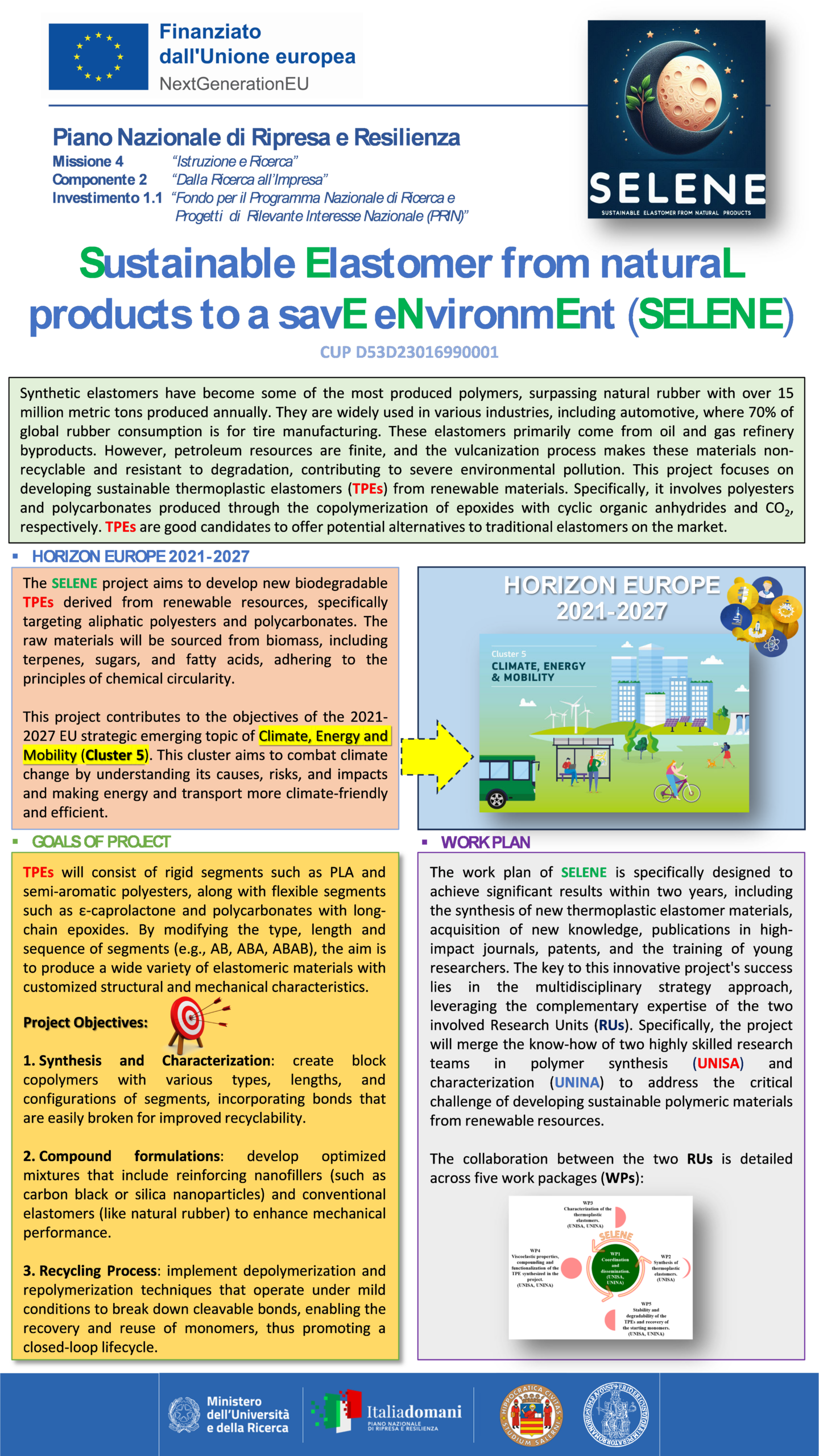
The SELENE project (Sustainable Elastomers from Natural Products for a Safer Environment) is focused on the development of a new generation of sustainable thermoplastic elastomers (TPEs) derived from renewable resources.
The core objective of the project is to design and synthesize biodegradable elastomeric materials based on aliphatic polyesters and polycarbonates, obtained from biomass-derived building blocks such as terpenes, sugars, and fatty acids. These materials are intended to replace conventional petroleum-based elastomers, which are typically non-recyclable and contribute significantly to environmental pollution.
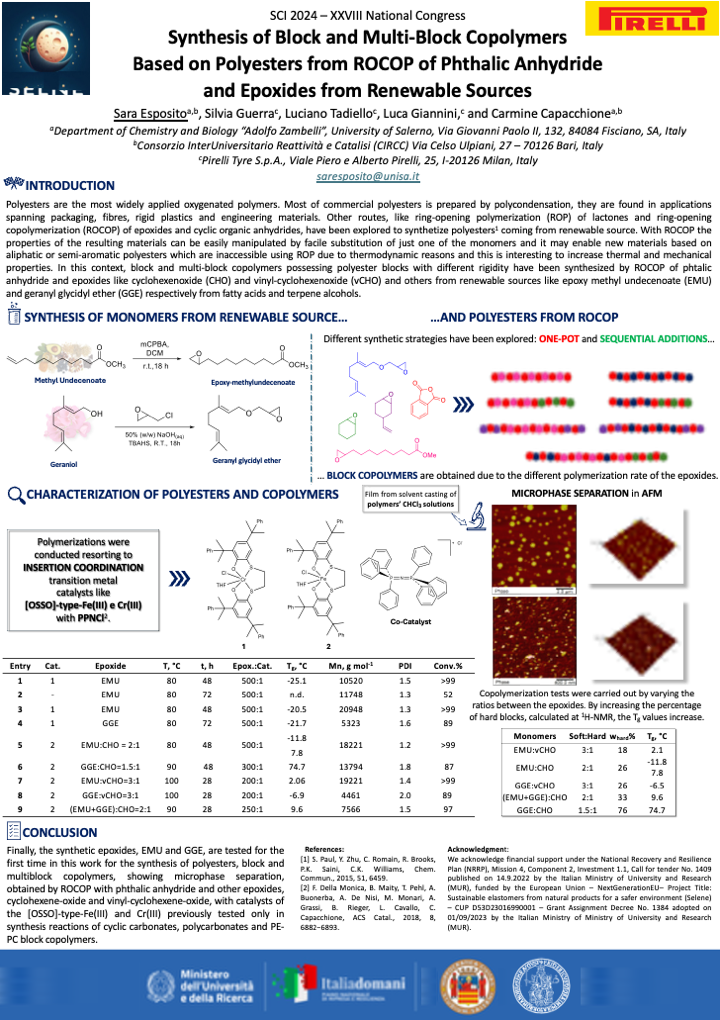
A key innovation of SELENE lies in the development of block and multiblock copolymers with precisely controlled architectures, combining rigid and flexible segments. By tailoring the chemical nature, length, and arrangement of these segments, the project aims to obtain materials with tunable mechanical and structural properties, suitable for advanced applications.
In parallel, the project addresses one of the major limitations of current elastomeric materials: their lack of recyclability. SELENE introduces cleavable chemical bonds within the polymer structure, enabling controlled depolymerization processes under mild conditions. This approach allows the recovery of the original monomers and their reuse in new synthesis cycles, promoting a closed-loop lifecycle fully aligned with the principles of circular economy.
From both a scientific and technological perspective, SELENE aims to establish a novel class of elastomeric materials that combine high performance, sustainability, and recyclability.
In summary, SELENE seeks to redefine the lifecycle of elastomeric materials, transforming them from environmentally persistent products into sustainable, recyclable, and high-performance solutions for a safer future.
Contributions
A New Semicrystalline Polymer from Renewable Source: Poly-1,4-(3-methylene-cyclopentene) as an Example of Three-Dimensional Topotactic Transition Triggered by Temperature
C. Napolitano, V. Paradiso, M. Naddeo, D. H. Lamparelli, F. Grisi, O. Ruiz de Ballesteros, G. Femina, C. Capacchione, and F. Auriemma; Macromolecules 2024 57 (15), 7409-7417
https://doi.org/10.1021/acs.macromol.4c01563
Synthesis and Characterization of β-Myrcene-Styrene and β-Ocimene-Styrene Copolymers.
R. Marzocchi, I. Grimaldi, O. Ruiz de Ballesteros, G.Femina, A.Guida, R.Ricciardi, P.Morvillo, C.Capacchione, F.Auriemma; Macromol. Rapid Commun.2024, 46, 2400641.
https://doi.org/10.1002/marc.202400641
Isoselective Polymerization of 1-Vinylcyclohexene (VCH) and a Terpene Derived Monomer S-4-Isopropenyl-1-vinyl-1-cyclohexene (IVC), and Its Binary Copolymerization with Linear Terpenes
Grimaldi, A. D’Amato, M. C. Gambardella, A. Buonerba, R. Marzocchi, F. Auriemma, C. Capacchione; Macromol. Rapid Commun. 2025, 46, 2400834.
https://onlinelibrary.wiley.com/doi/10.1002/marc.202400834
An old tool to obtain new polymers from renewable resources: [OSSO]-type titanium-catalysed ethylene and myrcene copolymers
F. Niknam, A. Buonerba, D. H. Lamparelli and C. Capacchione; Faraday Discuss., 2026,262, 152-168
https://doi.org/10.1039/D5FD00046G